
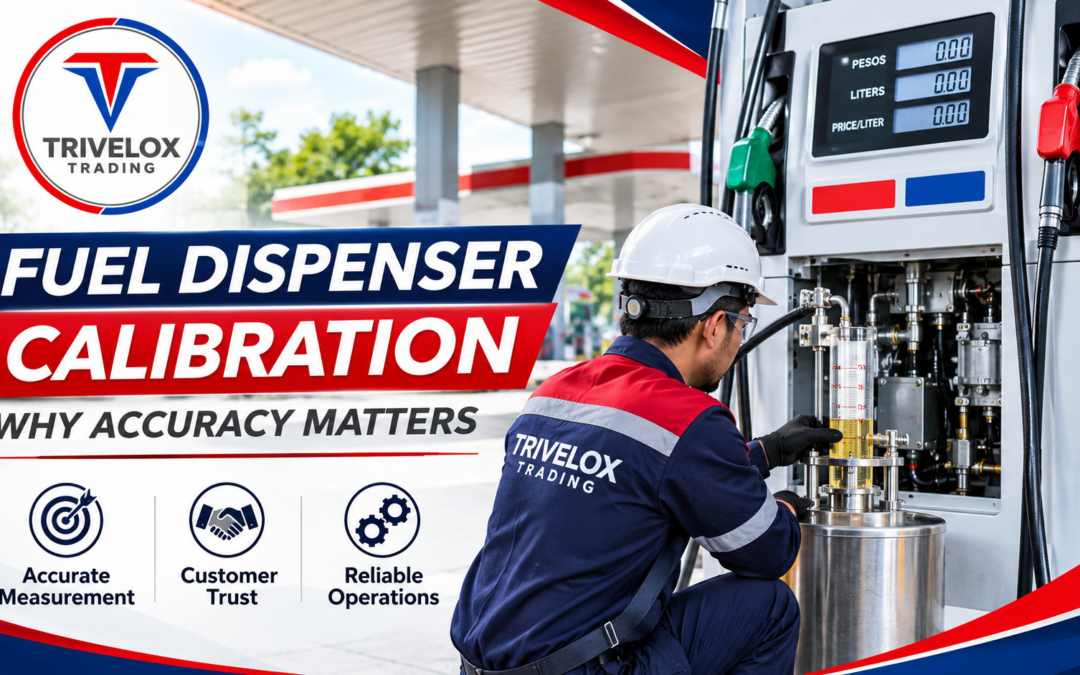
Fuel dispenser accuracy is essential for gas stations in the Philippines. Customers expect to receive the correct amount of fuel they pay for, while station operators need reliable equipment for daily operations.
Over time, fuel dispensing equipment may require professional inspection, testing, calibration, or repair to maintain accurate performance. Understanding fuel dispenser calibration can help gas station owners recognize potential issues and know when to seek qualified technical assistance.
In this guide, Trivelox Trading Inc. explains the importance of fuel dispenser calibration, common signs of possible measurement problems, and why professional service matters.
What Is Fuel Dispenser Calibration?
Fuel dispenser calibration involves checking the accuracy of the amount of fuel delivered by a dispenser against its indicated measurement. The process helps determine whether the equipment is measuring and dispensing fuel within the applicable tolerances.
Proper calibration checks can help gas station operators identify measurement discrepancies, maintain reliable equipment, and support customer confidence.
Calibration should be performed by qualified personnel using suitable equipment and procedures. Any legally required verification must be handled by the appropriate authorized personnel or authorities.
Why Is Fuel Dispenser Calibration Important?
Accurate fuel measurement is important for both customers and gas station operators. A dispenser that measures incorrectly can lead to complaints, financial discrepancies, and interruptions to normal station operations.
Here are several reasons to pay attention to calibration:
1. Helps Maintain Accurate Fuel Measurement
A properly checked dispenser helps ensure that the displayed quantity corresponds to the fuel delivered, within the applicable measurement tolerances.
2. Supports Customer Trust
Customers expect transparent and accurate transactions. Reliable dispensing equipment helps build confidence in your gas station.
3. Helps Identify Equipment Problems
Unusual readings or inconsistent dispensing may indicate a problem that requires inspection, testing, or repair.
4. Supports Business Operations
Reliable fuel dispensers help reduce avoidable disruptions and support smoother daily operations.
5. Helps With Compliance
Gas station operators should follow applicable Philippine requirements for measuring instruments, verification, and inspection. Calibration alone does not replace any legally required verification or certification.
Signs Your Fuel Dispenser May Need Calibration or Inspection
Not every dispensing problem is caused by calibration. However, certain signs may indicate that your equipment needs professional attention.
1. Inconsistent Fuel Measurements
If measurement results appear inconsistent during appropriate checks, the dispenser may need further testing.
2. Unusual Differences in Dispensing Results
Unexpected discrepancies between indicated quantities and properly measured test results should be investigated by qualified personnel.
3. Changes After Equipment Repair
Repairs, replacement of components, or adjustments may affect dispenser performance. Appropriate testing should be conducted after service.
4. Unusual Meter Behavior
Unstable readings, display irregularities, or other unusual behavior may indicate an electronic, mechanical, or measurement-related problem.
5. Repeated Customer Complaints
If customers repeatedly raise concerns about fuel quantity, have the equipment inspected rather than assuming the cause.
These signs do not automatically prove that a dispenser is inaccurate. Professional testing is needed to identify the actual cause.
What Can Affect Fuel Dispenser Accuracy?
Several factors can affect fuel dispenser performance and measurement.
Worn or Damaged Components
Mechanical parts may wear over time, potentially affecting operation and measurement performance.
Metering System Problems
Issues involving the meter or associated components may lead to inconsistent readings and require professional testing.
Electronic or Display Faults
Electronic components, wiring, sensors, or display problems can affect the information shown to the operator or customer.
Improper Adjustments
Unqualified adjustments may affect equipment performance and create additional problems. Only qualified personnel should perform calibration or technical adjustments.
Lack of Regular Maintenance
Ignoring warning signs and routine maintenance needs may allow small equipment problems to become more serious.
How Often Should a Fuel Dispenser Be Calibrated?
There is no single interval that applies to every dispenser in every situation. The appropriate schedule depends on the equipment, manufacturer recommendations, operating conditions, maintenance history, and applicable Philippine requirements.
Gas station operators should:
- Follow the manufacturer’s service and maintenance recommendations.
- Observe applicable inspection and verification requirements.
- Arrange professional testing when measurement concerns arise.
- Have the dispenser checked after relevant repairs or component replacement.
- Keep records of inspections, service work, and required verification.
Consult qualified service personnel or the relevant Philippine authority to determine the requirements for your particular equipment.
Fuel Dispenser Calibration vs. Repair
Calibration and repair are related, but they are not the same.
Calibration focuses on checking measurement performance and determining whether the dispenser meets the applicable accuracy requirements.
Repair involves diagnosing and correcting a fault, such as a damaged component, electronic malfunction, wiring problem, or mechanical issue.
A dispenser may need repair before its measurement performance can be checked properly. In other cases, inspection may show that a measurement-related adjustment or verification is needed.
The correct service depends on the results of professional testing and diagnosis.
How to Maintain Fuel Dispenser Accuracy
Regular maintenance can help keep fuel dispensing equipment in good operating condition.
Consider these practical steps:
- Schedule maintenance according to the manufacturer’s recommendations.
- Monitor unusual readings, error messages, and changes in dispensing performance.
- Arrange prompt inspection when measurement concerns occur.
- Keep records of maintenance, repairs, testing, and required verification.
- Use qualified technicians for technical work.
- Use suitable replacement parts that meet the equipment’s specifications.
- Avoid unauthorized adjustments to measurement-related components.
- Follow applicable safety procedures during inspection and servicing.
Never attempt to open or repair fuel dispensing equipment while it is operating or in an unsafe environment. Fuel systems can present fire, electrical, and other serious hazards.
When Should You Call a Professional?
Contact qualified service personnel if your dispenser shows inconsistent measurements, unusual meter behavior, repeated errors, or performance problems that cannot be safely resolved through normal operator checks.
Professional assistance may also be appropriate after repairs, component replacement, or other work that could affect measurement performance.
If there is a fuel leak, strong fuel odor, or another immediate safety concern, stop using the affected equipment, follow your station’s emergency procedures, and have the area assessed by qualified personnel.
Fuel Dispenser Services in the Philippines
Trivelox Trading Inc. provides fuel dispensing equipment and related support for businesses in the Philippines. Gas station operators can contact our team to inquire about fuel dispensers, parts and accessories, maintenance, troubleshooting, and service requirements.
Choosing suitable equipment and arranging qualified technical support can help gas station owners manage their equipment and maintain reliable operations.
For calibration-related concerns, ask about the appropriate inspection or service for your equipment and confirm any required metrology verification with the relevant authorized provider or authority.
Contact Trivelox Trading Inc.
Looking for fuel dispensing equipment, parts, or technical service support in the Philippines?
Trivelox Trading Inc.
- Phone: 0928 776 0108 / 0927 864 2223
- Email: [email protected]
- Website: https://trivelox.com
- Facebook: Triveloxtradinginc
- Address: Lot 11, Blk 4, Juanita Lane, Holy Family Village Phase 2, Angeles City, Pampanga 2009
Contact our team to discuss your fuel dispenser requirements.
Frequently Asked Questions
What is the purpose of fuel dispenser calibration?
Calibration checks help assess whether the amount indicated by a dispenser corresponds to the measured amount delivered, within the applicable tolerances.
Can fuel dispenser problems affect measurement accuracy?
Yes. Depending on the fault, mechanical, electronic, or metering problems can affect dispenser performance. Testing is needed to determine the cause.
Is calibration the same as repair?
No. Calibration concerns measurement performance, while repair addresses equipment faults. A dispenser may require both, depending on the findings.
Can I calibrate a fuel dispenser myself?
Fuel dispenser calibration and measurement-related adjustments should be handled by qualified personnel using appropriate procedures. Follow applicable Philippine requirements for verification and inspection.
Where can I inquire about fuel dispenser service in the Philippines?
You can contact Trivelox Trading Inc. through https://trivelox.com or call 0908-388-1072 to ask about equipment, parts, and available technical support.
Disclaimer: This article provides general information and is not a substitute for professional testing, equipment-specific instructions, or applicable legal metrology requirements.